


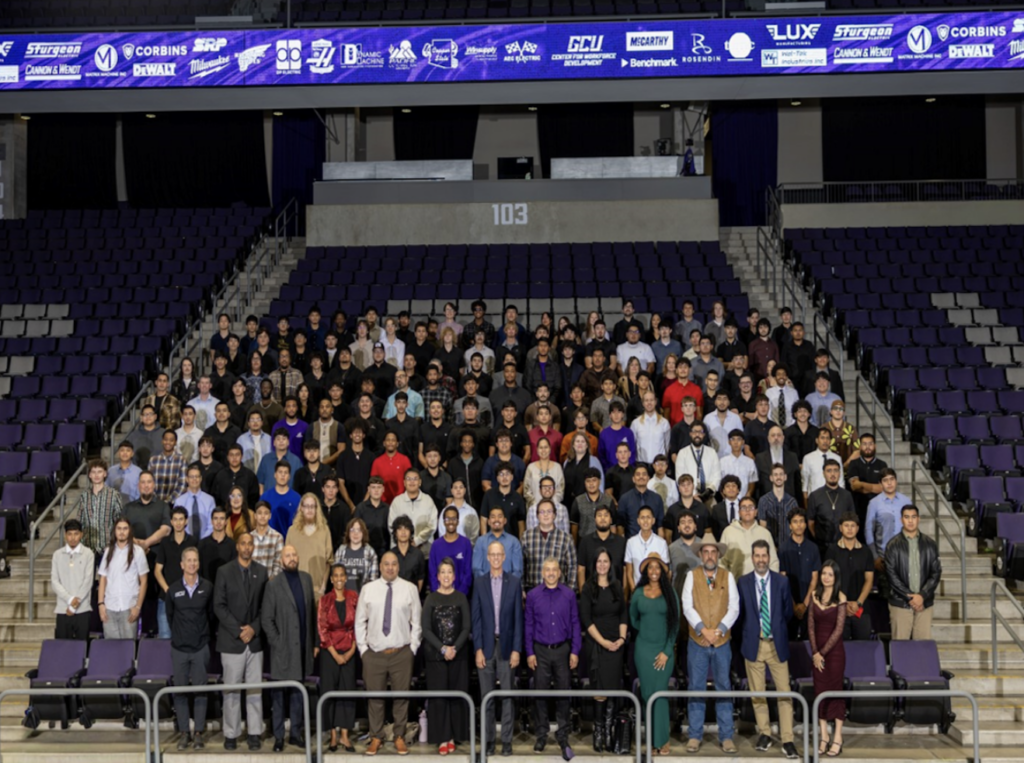
As part of its Center for Workforce Development, Grand Canyon University College of Engineering & Technology launched the Manufacturing Specialist Intensive (MSI) Pathway. This innovative initiative prepares students for careers in the rapidly expanding semiconductor industry, leveraging IEEE skills-based microcredentials to provide rigorous competency validation.
Challenge: Closing the Skills Gap
Higher education is facing a critical turning point. With fields like advanced manufacturing and AI evolving at rapid speeds, academic institutions are under immense pressure to ensure graduates possess the exact technical skills employers need today.
However, aligning traditional academic curricula with rapidly shifting industry requirements is a constant challenge. Universities need agile solutions that enhance the workforce relevance of their programs, increase speed-to-market for new training pathways, and maintain global academic rigor.
The Solution: A Triple-Helix Partnership Fueled by IEEE
To bridge this gap, GCU developed the MSI Pathway—a unique, collaborative workforce pipeline partnership with TSMC Arizona—and extended the program offering to students within the Deer Valley Unified School District.
Selected students participate in an accelerated, 11-week cohort, undertaking rigorous, college-level semiconductor and advanced manufacturing coursework taught by GCU faculty. Students who successfully complete the program earn 16 university credits at no cost to them.
The IEEE Microcredential Difference
What sets the MSI Pathway apart is the integration of IEEE skills-based microcredentials. Unlike traditional certificates that simply measure seat time, an IEEE microcredential is a competency-based validation backed by the world’s largest technical professional organization. An IEEE microcredential provides:
- Industry-Trusted Validation: It formally recognizes the acquisition of specific knowledge areas, skills, and abilities technicians need on day one.
- Stackable Value: When stacked together, these microcredentials validate broader, complex engineering competencies.
- Seal of Excellence: By embedding the IEEE seal into the curriculum, GCU gives students a globally-recognized competitive edge while reinforcing the university’s reputation for immediate workforce readiness.
Proven Results: High Completion, Extraordinary Placement
Launched in the summer of 2025, the MSI Pathway has delivered immediate, measurable ROI for students, the university, and its industry partners. The Metric Performance Summary for the first two cohorts to complete the program is as follows:
- Strong Retention: Out of 59 students enrolled across the initial cohorts, 49 completed the coursework—representing an 80%+ completion rate.
- Direct Employment Pipeline: A staggering 71% of program completers (35 students) received immediate offers of employment from TSMC.
- Long-Term Retention: The current employee retention rate at TSMC for these student hires stands at 90%+.
Program Momentum: The momentum is accelerating. The fourth cohort for Summer 2026 just concluded with 43 students completing the program and the latest program offering for Fall 2026 is underway with 60+ students.
Scalable Success for Modern Universities
The GCU model proves that universities do not have to choose between foundational academic education and rapid workforce training. By integrating IEEE microcredentials into existing or specialized curricula, higher education institutions can seamlessly translate classroom learning into industry-trusted capabilities.
Partner with IEEE to elevate your institution’s programs, accelerate graduate employment outcomes, and deliver the verified skills today’s technical industries demand here.